Sunday, December 5, 2021

Ghostbusters: Afterlife

Ghostbusters: Afterlife; fantasy, USA, 2021, D: Jason Reitman, S: Mckenna Grace, Finn Wolfhard, Logan Kim, Carrie Coon, Paul Rudd, Celeste O'Connor, Olivia Wilde, Dan Aykroyd, Bill Murray, Ernie Hudson, Annie Potts, Sigourney Weaver  

After inheriting a house in the rural Summerville, two kids, Phoebe (12) and Trevor (15) and their mom move there. Strange things keep happening in town, until the kids realize that their grandfather was the late Egon Spengler, a Ghostbuster. The latter set up an entrapment for the dark forces of Gozer, but they were freed from a coal mine built by Ivo Shandor. With the equipment of her grandfather, and the original Ghostbusters Peter, Ray and Winston, the kids are able to trap Gozer and save the town from an apocalypse.  

A belated semi-sequel to “Ghostbusters II”, “Afterlife” is a soft reboot that is decent, though it works far better in the first half, when it strives to be original, then in the second half, when it strives to just be a predictable clone. The director Jason Reitman creates good new characters, the next generation of Ghostbusters, and the most is achieved in the charming Phoebe, who, although underwritten, still hints at a greater potential. Reitman also writes himself around the fact that Spengler did what he did, even though the scientist would never do that. The opening is pretty clever: a Ghostbuster is chased by an invisible ghost on a farm, and attempts to catch it in his trap—but due to a power outage, there is no electricity, making the trap null and void. Some of the lines of the kids have wit: for instance, one of them, annoyed by living in such a small, insignificant town, jokes:“I'm 4th generation dump". Phoebe also jokingly defends her brother at one point: “Technically, most of 15-year olds are virgins”. Paul Rudd also shines here and there as the lazy school teacher, who is so negligent he plays the horror movie "Cujo" in the class on TV. The new technical additions and gadgets include a remote powered ghost-trap on wheels that comes in handy during a car chase. Unfortunately, the second half is hijacked by copy-paste nostalgia references to the original, of which it becomes too much of a slave. The finale makes the same mistake as “Star Wars: The Rise of Skywalker”, by just recycling the ending of the original, since having Gozer appear for a second time around feels too similar to the ending of “Ghostbusters”, which is too close to plagiarism. Had Ivo Shandor been the main villain, it would have all made far more sense. As if the character arcs are forgotten at that point, and the movie ends suddenly without an epilogue. Due to such excessive use of references and the iconography of the famed original in the last third, people cannot agree upon if it is a worthy homage or exploitation. "Afterlife" mostly succeeds in reviving the franchize, but it also shows how each subsequent "Ghostbusters" film is in one way or another a rip-off of the 1st film.

Grade:++

Saturday, December 4, 2021

Mila

Mila; computer animated war drama short, USA, 2021; D: Cinzia Angelini

Trento, Italy, World War II. Mila, a little girl, rides a Carousel horse with her mother. Allied war planes start the bombing campaign of the city, and her mom dies in the carnage. A woman randomly saves Mila and takes her in at her home. The two stay over the night, and the woman repairs Mila's hat and plays with her. The next day, the two go out, and peace returns to the city.

A gentle, emotional and melancholic animated short film, based on a true story, "Mila" explores the effects of war on kids, in this case the title heroine who becomes an orphan in World War II. The director Cinzia Angelini chooses a story without any dialogue, relying instead only on a visual depiction of events, small gestures and symbols to tell the tale. A somewhat too austere, too straight-forward depiction of this simple story, which needed more inspiration or finesse, "Mila" is still undoubtedly a good film, where some of the crucial moments appear so subtly the viewers might miss them if they blink. For instance, the death of Mila's mom on the Carousel after the bombing is never depicted directly, and she can only be seen lying on the side for a couple of seconds. In another, the woman who adopts Mila repairs the little girl's hat, as to keep the last memory of her life before the bombing for her. An easily accessible, but also demanding and ambitious little film, "Mila" is a compact, but touching tale. 

Grade:++

Wednesday, December 1, 2021

The Policeman

HaShoter Azoulay; comedy, Israel, 1971, D: Ephraim Kishon, S: Shaike Ophir, Avner Hizkiyahu, Zaharira Harifai, Itzko Rachamimov, Yosef Shiloach, Nitza Saul  

Tel Aviv. Police officer Azoulay never notices any criminal activity around him, and thus his superior, police chief Lefkowitch, intends to not renew his contract. Azoulay is unhappily married with the overweight, cigarette addicted Betty, and they have no kids. He mistakes an innocent man in a cinema for an Arab suicide bomber. He also unwillingly arrests prostitute Mimi in a raid, but they remain friends on the street. Upon hearing that Azoulay will be replaced, criminals stage a fake robbery to have him arrest one of them, so that he could stay in the police precinct. Azoulay is thus promoted to a Sergeant, but immediately sent to retirement by Lefkowitch, to not mess anything up.  

Even though it is regarded as a classic in Israel, this gentle police comedy made in the vein of Czech humor does not feel as fresh anymore, since the director Ephraim Kishon was not as inspired as Ephraim Kishon the novelist, leaving the film feeling thin, overstretched and with several ‘empty walks’ here and there. It is simply not that funny, featuring several cheesy or forced gags trying too hard to be sympathetic. “The Policeman” works the most thanks to the main actor Shaike Ophir as Azoulay, a more grounded, tragic version of Inspector Clouseau, and, especially, wonderful supporting actress Nitza Saul as the good-hearted prostitute Mimi, who awakens Azoulay’s dormant emotions, and one almost wishes the movie should have explored their relationship more and made her the lead, instead of just letting her “disappear” in the entire second half. 

The best jokes arrive swiftly and unexpectedly: in the police station, police chief Lefkowitch is annoyed when he sees the wall plastered with mugshots of criminals, and spots that some prankster placed a newspaper photo of Yasser Arafat among them. Azoulay is watching a black-and-white crime film on TV and imagines himself starring in it, beating up criminals in a warehouse to save his beloved Mimi. Finally, when the news hits that the absent-minded police officer Azoulay will be fired because he never notices any crime acts around him, the criminals panic, knowing he was their “unwilling accomplice” for years and fearing that now a new, tougher cop will disrupt their business, so they concoct a hilarious plan of stealing artifacts from a monastery, all to get deliberately caught by Azoulay. When Azoulay arrests and handcuffs the volunteer criminal, the later pulls out Azoulay’s pistol behind his back, just to prove how silly this whole thing is, yet then holsters it back again. Even while being taken away to prison in a police van, the criminal just suddenly bursts into laughter while watching the oblivious Azoulay who “caught” him. Truly, the only sequence that rises to the occasion and reaches Kishon’s best days. The final image takes a more somber route by sending a bitter message: you never get what you really wanted in life, and then it’s all over.  

Grade:++

Tuesday, November 30, 2021

Toma

Toma; drama, Serbia, 2021; D: Dragan Bjelogrlić, Zoran Lisinac, S: Milan Marić, Tamara Dragičević, Petar Benčina, Andrija Kuzmanović, Marko Janketić, Ivan Zekić, Srđan Todorović, Milena Radulović

"Happy people don't write songs". The life of folk singer Toma Zdravković (1 9 3 8-1 9 9 1): as a lad, he worked in Leskovac as a waiter, but then met famous singer Silvana Armenulić, who came for a guest concert at his tavern, and they teamed up to sing together, with success. They repeat that in Tuzla. Toma falls in love with her, but she leaves without saying goodbye to work abroad, where she marries Radmilo. Toma meets Nada when he was a judge at a Miss Beauty pageant, and they get married. Nada cheats on him, so Toma divorces her and goes to Chicago to sing Italian and Spanish songs at local pubs. Silvana phones Toma to inform him of her upcoming American tour, but dies in a car accident. A disappointed Toma spends numerous nights gambling, drinking alcohol and smoking. He marries Gordana, they get a child and return back to Yugoslavia. Toma is diagnosed with cancer, but continues his tour as the Yugoslav Wars are about to ignite. He dies.

A biopic about singer Toma Zdravkovic—a rare and unusal subgenre among the post-Yugoslav countries—became a surprise hit in the area (over 600,000 tickets sold in Serbia and Bosnia) because of the nostalgia factor for those folk singers from the 70s and 80s, and is an overall good an honest little film, but it is still more interesting emotionally than cinematically or stylistically. The tragic story of its title hero, who rose through the ranks from being a waiter to one of the most sucessful singers in Yugoslavia, yet was broken from his unrequited love from Silvana Armenulic, is gripping, fluent, dramatic and touching, since Toma was a hedonist, but ultimately a man with a pure heart, and the main actor Milan Maric delivered an excellent performance. While conventional in its storyline, "Toma" has several memorable quotes which stay in your head. In one humorous scene, while waking up in the hospital after collapsing after a concert, the Doctor asks: "Are you married?", and Toma is quick to reply: "If that's what wrong with me, I am willing to immediately get divorced, doc!" A different, more somber moment has Toma explaining to the Doctor: "It doesn't matter how long your life is. It's how much life you insert into each day." The Doctor undergoes an amazing transformation, from the standard type who discourages Toma from doing a concert due to his bad health, up to the Doctor being the main catalyst of urging Toma to never stop doing new concerts, knowing that they are the only thing still giving him the will to go on and live. After Doctor's wife dies from a terminal illness, he says to Toma: "She wanted to have kids, but I said that there is time for that. Now I know there is never time." As Toma's health was deteriorating in the 90s, so was Yugoslavia as a state, drawing a parallel of the end of times and the cycle of change.

Grade:++

Sunday, November 21, 2021

Captain Marvel

Captain Marvel; fantasy, USA, 2019; D: Anna Boden, Ryan Fleck, S: Brie Larson, Samuel L. Jackson, Ben Mendelsohn, Jude Law, Djimon Hounsou, Lee Pace, Lashana Lynch, Annette Bening, Gemma Chan

Vers, a blond woman, is member of the Starforce, a branch of the Kree civilization. Her mentor, Yon-Rogg, assigns her to fight against another alien race, the shapeshifting Skrulls, alleging that they want to get a fast-than-light device to invade far corners of the Galaxy. After briefly remembering unknown flashbacks from her past on Earth, Vers decides to travel to said planet to find Dr. Wendy Lawson, who invented the device. It is 1 9 9 5. Vers teams up with S.H.I.E.L.D. agent Nick Fury to try to find the device. It turns out Vers was a human, Carol Danvers, who worked for the U.S. Air Force, testing the device until it exploded, and her body absorbed its energy, so Yon-Rogg took her to Kree and gave her a new memory. Vers finds out that Skrulls are actually the good guys, who just want to find a new home to escape from Krees who wanted to subjugate them. Vers becomes Captain Marvel and uses her powers to defeat the Krees. Marvel leaves with the Skrulls, but leaves Fury with a pager to contact her in case of an emergency. 

The 21st movie of the Marvel Cinematic Universe, "Captain Marvel" is a 'too late' edition to the franchize, shoehorned just before the big showdown in "Avengers: Endgame", yet it still works as a good and fun piece of entertainment. By this time, the Marvel CU became something of a McDonalds for superhero movies, producing at least two per year, but even though they were giving comic-book fans just what they liked, they still delivered interesting movies. "Captain Marvel" shows that Marvel has quite imaginative fantasy or sci-fi stories to tell, especially in the intruiging twist in the vein of "The good guys fighting against the bad guys are actually the bad guys fighting against the good guys", where the heroine Vers finds out that she was mislead, which makes her a flawed, more likeable character that grows and corrects herself, whereas Brie Larson was restrained by the directors Boden and Fleck to not go overboard. The whole film is too mainstream and too accessible at times, trying to not offend anyone as to be as commercial as possible, whereas its best moments are smple jokes (Stan Lee has a delicious cameo as himself reading the "Mallrats" script; Vers enters a train and kicks a grandmother in the face, the passengers are shocked, but the grandmother suddenly starts fighting with Vers, since she is a shapeshifting Skrull), including Samuel L. Jackson as Fury, with a digital 'face-lift' (a funny gag has him looking under the sheet of a dead Skrull alien, to see how it looks like "down there", while the autopsy guy adds that the alien "is no Brad Pitt"). The final 25 minutes are the worst, giving Captain Marvel ridiculously impossible superpowers, to such an extent that not even Superman with Super Mario's super star power wouldn't be able to compete with her, making the stakes very low in the story. Nonetheless, this light superhero movie is fun, dynamic and competent in its own way, and still fits in inside Marvel CU.

Grade:++

Friday, November 12, 2021

Chimes at Midnight

Chimes at Midnight; art-film / drama, Spain / Switzerland, 1965, D: Orson Welles, S: Orson Welles, Keith Baxter, Tony Beckley, John Gielgud, Margaret Rutherford, Jeanne Moreau, Alan Webb, Walter Chiari  

England, early 1400s. After killing Richard II, the new King Henry IV has to battle rebellions against his rule. He is annoyed that his son Prince Hal spends a lot of time with overweight, sloppy knight Falstaff, drinking at taverns and sleeping with prostitutes. Hal and Falstaff even rob some travelers in a forest, and Hal plays a trick on Falstaff, robbing even him under disguise. In the Battle of Shrewsbury, Hal kills rebel Henry Hotspur, dispersing his army. When Henry IV dies from a disease, Hal is proclaimed as the new King Heny V. Falstaff is overjoyed of the news at first, but Hal feigns to not know him. Saddened by the rejection, Falstaff dies.  

Included in Roger Ebert’s list of Great Movies, Orson Welles’ 10th feature film is an adaptation of William Shakespeare’s plays “Henry IV” part 1 and 2, yet due to its archaic, overlong and ponderous dialogues, it does not feel as fresh nor as alive anymore. The audio aggravates the intention of the viewers to try to understand the film, since the dub has problems, and thus subtitles are needed to decipher what the protagonists are saying at certain time. Welles was drawn to the character of the overweight, mumbling knight Falstaff who seems to mirror some of the director’s private traits, including the famous betrayal by Prince Hal when the latter becomes King Henry V, and cuts all ties with his immature past, and thus rejects Falstaff. However, Falstaff’s and Hal’s friendship never had that truly strong of a bond, since Hal acts more as if Falstaff is his butt of jokes and pranks. One great sequence shows them dressing up as monks, and as Hal tries to put on a white cloak on the corpulent Falstaff, he remarks: “How long is it Jack, since thou saw thine own knee?” 

After the robbery, Hal and his friend prank Falstaff and his entourage by dressing up in a black cloak and robbing their stolen money, only to later meet in a tavern and enjoy listening to Falstaff’s excuses and exaggerations in trying to justify how he was himself robbed: “There lives not three good men unhanged in England - and one of them is fat and grows old, God help the while.” Falstaff claims he fought four robbers, then seven, until the number grows to eleven. Finally, when Hal reveals it was he who robbed them while disguised, Falstaff tries to find even an excuse for that, by twisting it that he deliberately ran away because he recognized him: “Was it for me to kill the heir apparent? Should I turn upon the true prince?” This is a great little comedy scene, yet the movie doesn’t have that many of them. The famous Battle of Shrewsbury sequence is a little bit overhyped: it has realistic details (one knight pounding another one on the ground; several men in armor wiggling in mud like worms), yet all this is not half as interesting as the deliciously funny scenes of Falstaff, in his fat armor, peeking behind a tree, and then hiding again until all is over. The film has some traces of Welles’ sense for cinema in the well placed shot compositions and mise-en-scene (Hal standing next to his dead father on the throne, illuminated by a beam of light coming from the window of the castle), yet it never truly comes together as a whole, as if the whole story is, except for the ending, distant, schematic and too artificial to truly ignite. 

Grade:++

Saturday, November 6, 2021

Mallrats — Extended Cut

Mallrats; comedy, USA, 1995; D: Kevin Smith, S: Jeremy London, Jason Lee, Claire Forlani, Shannen Doherty, Michael Rooker, Ben Affleck, Jason Mewes, Joey Lauren Adams, Kevin Smith, Stan Lee

T.S. Quint is dumped by his girlfriend, Brandi, whereas Brodie is dumped by his girlfriend Rene. So T.S. and Brodie meet up at a mall with Jay and Silent Bob to forget about their troubles, which also includes waiting in line to see Marvel comic-book icon Stan Lee. Brodie is annoyed that Rene hooked up with womanizer Shannon Hamilton. Brandi's father Svenning stages a TV show at the mall, "Truth or Date", to try to sell it to potential sponsors, and Brandi is sent to be in it. T.S. and Brodie join the show. T.S. and Brandi make up; Silent Bob plays a sex tape involving Hamilton and an underage girl, which gets him arrested, and Svenning, too. Brodie and Rene make up, as well.

After entering the movie scene in big style with "Clerks", director and screenwriter continued it a step back with this chaotic shopping mall comedy, "Mallrats", which is, at least in the extended edition, forced and unworthy. Puzzlingly, Smith included vulgar, vile or tasteless jokes in order to appeal to the wide audience, but they just set up the movie to fail in advance: the fortune teller with three nipples, for instance, or the disasterous gag in which Brodie, as a revenge, sticks his hand in his butt, and then shakes his stinking hand with Svenning, touching it, mentioning his ring, and giving him chocolate, which Svenning eats with gusto, and licks his now dirty fingers. Why have this scene in the first place? It wrecks the movie, and lingers negatively, overshadowing the good parts. Some good lines live it up here and there. For instance, Rene tells her ex-boyfriend Brodie how she thinks about doctors who make advancements in curing diseases; engineers who design skyscrapers; navigators who map a plane's fly path... "people who lead big lives", adding at the end: "I think about all that and I cry, because I've got nothing better to do than f*** you". In another great verbal moment, T.S. and Brodie contemplate if "Louis' fallopian tubes can handle Superman's sperm", and how only "Wonder Woman's uterus is strong enough to carry his kid". Sadly, the movie needed more of such high level examples of humor, and less those low ones. The good, intellectual jokes are worth more than ten scenes of dumb jokes here, which are never as funny to truly justify going so low. 

Grade:+

Friday, November 5, 2021

Clerks II

Clerks 2; comedy, USA, 2006, D: Kevin Smith, S: Brian O’Halloran, Jeff Anderson, Rosario Dawson, Trevor Fehrman, Jason Mewes, Kevin Smith, Jennifer Schwalbach Smith, Jason Lee, Ben Affleck

New Jersey. Dante finds out his store caught fire and burned out. He finds a new job in a fast food restaurant. It is his last day there, since he plans to marry Emma and move to Florida. Things get complicated when his boss Becky reveals she is pregnant with him, whereas his friend Randal throws a farewell party inside, featuring a man having sex with a donkey. They are all arrested, but released soon. Dante proposes Becky and rebuilds his old store to work with Randal as friends again.  

12 years after his indie debut film “Clerks”, director and screenwriter Kevin Smith returned to his roots with this disappointing sequel that seems as if it was directed by an imposter imitating Smith. While the first film had no story, but its running time was filled out with consistently good jokes and dialogue, “Clerks II” is a movie whose running time is filled out with bad, lame jokes and dialogue, demonstrating for the first time that Smith has lost his touch, and instead settled for a populist comedy aimed at vulgar teens. The first truly great dialogue worthy of the level of the original is the sequence where Randal confronts two “LOTR” fans by summing up the entire “Lord of the Rings” film trilogy as this: first film, Randal walks across the floor. Second film, Randal walks across the floor. Third film, Randal walks across the floor, stops, and pretends to throw something from his hand. Truly delicious, but it happens only 25 minutes into the film, which is long for a first good gag. The next good one also happens only 25 minutes later, failing to cover up the lack of inspiration. One bad sequence wrecks the film: in the finale, for Dante’s farewell party, Randal accidentally hires a man who, it is implied, gives a blow job to a donkey, and later takes his underwear down to have intercourse with the animal. A disaster of poor taste. That the authors would resort to bestiality to try to keep the viewers’ attention is sad. “Clerks II” have more obscenity and vulgarity, to try to appeal to the wide audience, but its problem is that it’s simply not that funny. It is way too forced. The only good part is the surprisingly sweet relationship between Dante and Becky, yet everything else in not worth writing about. Despite a bigger budget, these "Clerks" have far less spirit.  

Grade:+

Thursday, November 4, 2021

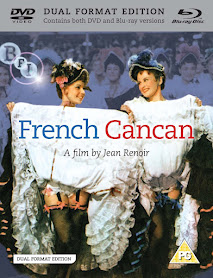
French Cancan

French Cancan; musical comedy-drama, France / Italy, 1955, D: Jean Renoir, S: Jean Gabin, Françoise Arnoul, María Félix, Anna Amendola, Jean-Roger Caussimon, Philippe Clay

Paris towards the end of the 19th century. Henri Danglard owns a night club that entertains the male audience with belly dancer Lola, who is also his lover. However, he owes a lot of money, and the shows are not going that well lately. One night, Danglard spots a girl, Nini, dancing French can-can, a dance from the 1840s, with her lover Paulo in a tavern, and is fascinated by her. The next day, Danglard persuades Nini to join his troupe so that he could organize a new night club, the Moulin Rouge, featuring can-can. Nini accepts money to finance the Moulin Rouge from Prince Alexander, but becomes Danglard’s lover, angering Paulo, and causing Alexander to try to shoot himself from a broken heart. Upon finding out Danglard found a new, younger lover, Esther, Nini refuses to dance on the opening night of the Moulin Rouge, but is finally persuaded to go out and dance with a dozen other women, because art is more important than personal problems. The premiere is a success.  

Included in Roger Ebert’s Great Movies list, “French Cancan” is an unusual turn in director Jean Renoir’s career, who surprised the critics with this departure from ambitious dramas to go on an excursion into a light, optimistic musical-comedy that celebrates life. At times it is indeed fresh and effervescent, depicting the origins of Moulin Rouge, yet at other times it feels stiff and dusty. Renoir uses the often trope of an artist in crisis who accidentally meets someone who inspires him of his greatest achievement—in this case, protagonist Danglard who is fascinated when he sees a girl, Nini, dancing the French can-can in a tavern with her boyfriend Paulo, and thus decides to put this dance on his regular schedule to attract an audience. Francoise Arnoul is simply fantastic as Nini, conveying both innocence and wild energy during dancing, establishing herself as the undisputed highlight of the film. Renoir uses all these dance trainings as an excuse to dwell on women’s bodies and their sensual lifting up of skirts, but when the result is this cheerful, then so be it. 

Renoir’s style is too conventional and ordinary, yet some of his details are poignant: in one, he shows the trials and tribulations of a performer’s life in the scene where Paulo threatens to cut all ties with Nini if she performs the can-can in front of a mass audience, since he considers it too intimate. In another, there is a codified “running gag” of Nini witnessing Danglard constantly meeting an old lady on the street and buying flowers from her, again and again, implying she was his former mistress, until this comes full circle when Nini spots Danglard kissing a younger girl backstage, causing Nini to revolt against his constant dumping of old lovers for younger ones. Not every scene is interesting, but there are some nice bits of trivial details that illustrate the feel of these artists living at that certain time and place—including a sequence where one of Danglard’s assistants brings croissants for the bankrupt troupe in the room, since she works in a cafeteria, and Danglard, in his pajamas, really cherishes this delicious meal for breakfast. The finale takes a long time, but offers a great dance of a dozen women doing the can-can, including Nini pulling up her skirt completely, leaning forward and showing her underwear to the audience. A surprisingly uplifting and relaxed film from the director, with enough good parts to cover up for the overstretched ones.

Grade:+++

Wednesday, November 3, 2021

Bombshell

Bombshell; drama, USA, 2019; D: Jay Roach, S: Charlize Theron, Margot Robbie, Nicole Kidman, John Lithgow, Allison Janney, Kate McKinnon, Mark Duplass, Malcolm McDowell, Connie Britton 

2 0 1 6. One strike, and you’re out—after posing some unexpectedly tough questions to Presidential candidate Donald Trump, Fox News reporter Megyn Kelly is lambasted by Trump’s fans on the Internet, while the CEO of Fox News, Roger Ailes, offers no support. A new employee, Kayla, wants to be a host of a show, but Ailes’ audition consists of insisting that she lifts her skirt up. Every female host has to be a "bombshell" if she wants to work for Ailes. The ageing host of the network, Gretchen Carlson, is fired, ostensibly due to low ratings, and decides to sue Ailes for sexual harassment. Gretchen finds support in Kayla, who confirms Ailes wanting sexual gratification from women for promotion. Ailes is replaced, while Robert Murdoch takes over Fox News until a new replacement is found.  

“Bombshell” is a bitter commentary on certain corporate companies where women have to “sexually sell” themselves to a male boss in order to get a promotion and climb up the hierarchy, depicting that there were more millionaires using the “Harvey Weinstein-method” than expected, among them even Fox News CEO Roger Ailes. The sequence where Kayla (very good Margot Robbie) wants to advance into a host on a TV show, and her audition consists out of Ailes ordering her to lift up her skirt, more and more, until her underwear is seen, under the excuse that “TV is a visual medium”, really is uncomfortable and gets that dreaded point across. Some dialogues by screenwriter Charles Randolph dissecting Fox News mentality and its aggressive push towards conservative ideology have spark (“People don’t stop watching when there’s a conflict. They stop watching when there isn’t one”; “Ask yourself, what would scare my grandmother or piss off my grandfather? And that’s a Fox story”), yet they are sparse, and the storyline feels too often like a schematic PowerPoint presentation. Even the ending feels anticlimactic and lukewarm. In the 21st century, a certain type of movies based on true events seem to have undergone a Michael-Mooreization of sorts, catering too much towards the liberal viewers. “Bombshell” is more of a docudrama than an actual movie; it thus stimulates more thematically than cinematically, proving that, despite their noble intentions, activist movies mostly do not have that coveted permanent value.  

Grade:++